CHEXX and PAGCOR: Philippine Licence Status, Online Gaming Rules and Tax
No PAGCOR local licence or registered CHEXX brand entry was found in the current official Philippine sources. PAGCOR’s own Guarantee portal is a directory of PAGCOR-authorized online gaming websites, and CHEXX is not listed there. The current PAGCOR registered-brand/domain PDFs also contain no CHEXX or Continent Gaming match.
That does not mean “all online gambling is banned” in the Philippines. PAGCOR continues to license and regulate domestic electronic gaming, while Republic Act No. 12312, the Anti-POGO Act of 2025, bans offshore gaming operations conducted in the Philippines. BIR RMC 57-2026 separately places jackpot prizes or similar casino/gambling winnings within final-withholding-tax rules. These are different regulatory questions and should not be collapsed into one slogan.
CHEXX in the Philippines: what is verified
| Question | Current evidence | Practical meaning |
|---|---|---|
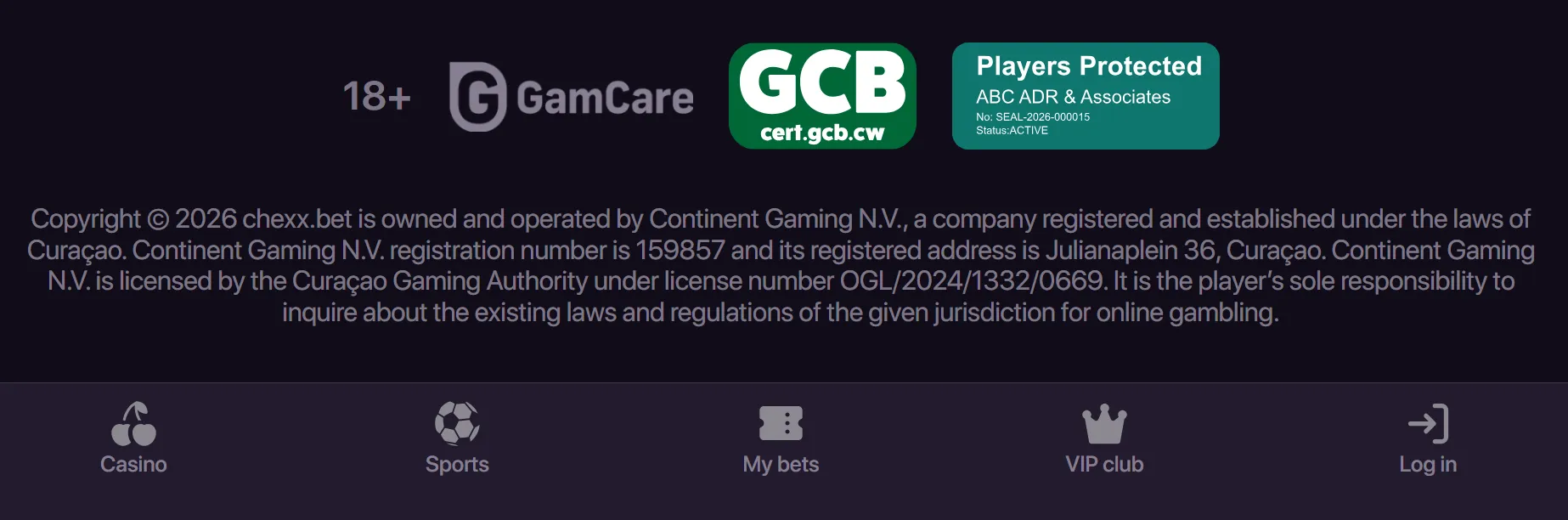
| Does CHEXX have a foreign gambling licence? | Yes. Curaçao Gaming Authority licence OGL/2024/1332/0669 is tied to chexx.bet. | This establishes a Curaçao licence, not a Philippine licence. |
| Is CHEXX listed as PAGCOR-authorized? | No CHEXX or Continent Gaming entry was verified in the current checked PAGCOR lists or PAGCOR Guarantee. | Do not describe CHEXX as PAGCOR-approved. |
| Does PAGCOR still regulate domestic online gaming? | Yes. Its Electronic Gaming Licensing Department continues to license local eCasino, sports betting and other electronic gaming operations. | The Philippine framework is not a blanket ban on all online gambling. |
| What did the Anti-POGO Act ban? | Offshore gaming operations in the Philippines. | Do not equate the POGO ban with abolition of PAGCOR-regulated domestic e-gaming. |
| What is the current age rule in the PAGCOR framework? | Persons under 21 are not allowed to gamble. | This is a Philippine regulatory rule for PAGCOR-regulated gambling. |
| Is there a current tax rule for gambling winnings? | BIR RMC 57-2026 covers jackpot prizes or similar casino/gambling winnings under final withholding tax rules. | Tax treatment is a separate issue from licence status and is not personal tax advice. |
No PAGCOR local licence was verified for CHEXX
The current PAGCOR Electronic Gaming Licensing Department page links official lists of accredited gaming system administrators, registered brands, domains and licensed-casino online brands. The current GSA and registered-brand/domain list is dated August 12, 2026. A text check of that official PDF found no CHEXX and no Continent Gaming. The current licensed-casino brand/domain PDF likewise contains no match.
PAGCOR Guarantee provides another local check. The portal describes itself as a directory of PAGCOR-authorized online gaming websites and currently displays a long list of named Philippine gaming brands and domains. CHEXX is not included in the surfaced current directory. PAGCOR says the Guarantee service exists so the public can verify whether an online gaming site is duly licensed under PAGCOR’s oversight.
The correct conclusion is therefore narrow and direct: no PAGCOR local licence was verified for CHEXX in the checked official sources. That is not the same statement as “CHEXX has no licence anywhere.” CHEXX has a separate Curaçao licence, explained on the CHEXX licence page. A foreign licence and local Philippine authorization are different evidence layers.
Do not substitute access for authorization
The current CHEXX terms do not list the Philippines among the prohibited jurisdictions. That supports an access/availability observation about the brand’s own terms. It does not create a PAGCOR licence, and it should not be used as proof of Philippine authorization.
What a PAGCOR listing would actually change
A verified PAGCOR brand or domain entry would provide evidence of local Philippine authorization within PAGCOR’s current framework. It would not automatically prove that every promotion is current, every cashier route is available, every game is suitable, or every account dispute will be resolved in a particular way.
The inverse is also important. CHEXX’s absence from the current PAGCOR sources means PAGCOR approval should not be claimed. That does not erase the separate evidence that Continent Gaming N.V. operates chexx.bet under a Curaçao Gaming Authority licence. The foreign licence and the Philippine local-listing question remain separate.
This approach helps readers compare claims precisely. If a marketing page says “licensed,” ask which regulator. If it says “available in the Philippines,” ask whether that means the brand does not block the country or whether it has a domestic PAGCOR listing. If it says “legal,” ask what specific law or authorization supports that conclusion. The wording matters because those claims are not interchangeable.
What PAGCOR regulates in domestic electronic gaming
PAGCOR states that it regulates games of chance and issues licences to gaming operations within Philippine territory. Its Electronic Gaming Licensing Department handles local operations involving traditional bingo, eBingo, eCasino games, sports betting, specialty games, online poker and numeric games, along with approval processes for gaming platforms and content.
This current licensing activity matters because it corrects a common overstatement. Philippine online gambling policy has tightened sharply, especially around offshore operations, payments, advertising and harm reduction, but PAGCOR’s own 2026 pages still show an active domestic electronic-gaming licensing framework. July 2026 announcements include work on a Unified Gaming License, and the regulator continues to publish authorized brands and approved online gaming websites.
When a website claims Philippine authorization, the relevant question is whether the brand or domain is actually present in PAGCOR’s current official ecosystem. A foreign licence, a reachable website or the ability to create an account does not answer that local-regulator question.
The Anti-POGO Act does not mean all domestic e-gaming is banned
Republic Act No. 12312, signed on October 23, 2025, is titled the Anti-POGO Act of 2025. The law declares offshore gaming operations in the Philippines banned and unlawful. This followed the earlier cancellation of PAGCOR offshore gaming and internet gaming licences, which PAGCOR says were cancelled effective December 15, 2024.
The key word is offshore. The Anti-POGO Act addresses offshore gaming operations conducted in the Philippines. PAGCOR’s current domestic Electronic Gaming Licensing Department remains active and continues to describe licensing for local eCasino, sports betting and other electronic gaming operations. Reading those sources together avoids the false conclusion that Republic Act No. 12312 erased every form of PAGCOR-regulated domestic online gaming.
This also means the CHEXX question should not be answered by saying “POGOs are banned, therefore CHEXX is automatically illegal” or “domestic e-gaming exists, therefore CHEXX is automatically authorized.” Neither shortcut follows from the sources. The specific local check for CHEXX remains the PAGCOR register and PAGCOR Guarantee result, where no matching local authorization was verified.
PAGCOR Guarantee is the practical local verification tool
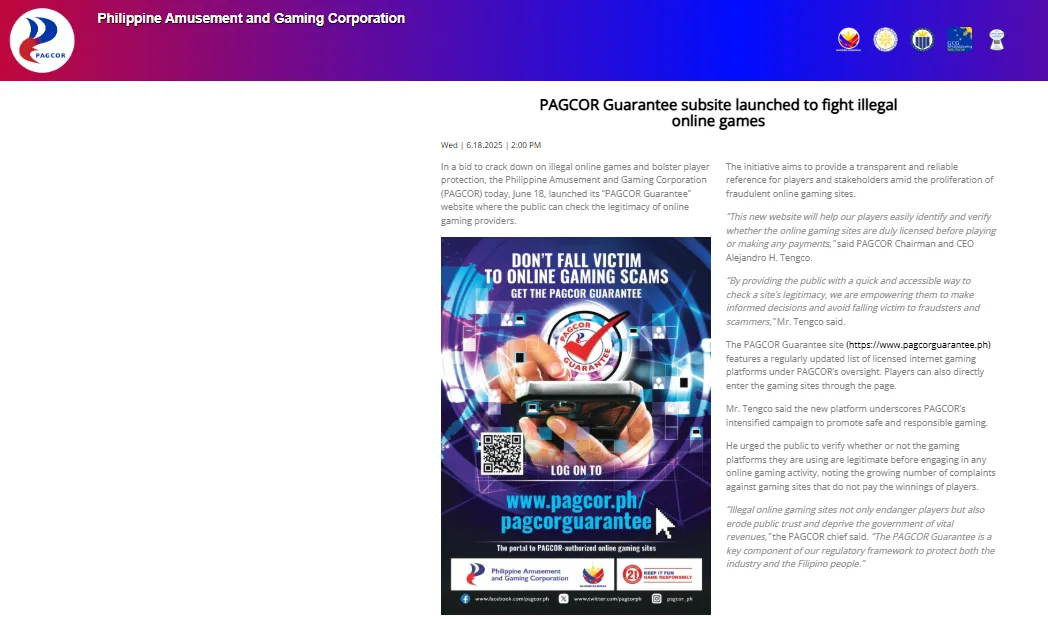
PAGCOR launched the Guarantee site in June 2025 as a public verification resource. PAGCOR’s launch notice says the service lets players check whether online gaming sites are duly licensed and describes the portal as a regularly updated list of licensed internet gaming platforms under PAGCOR oversight.
The current portal is useful because it translates a regulatory question into a simple user action: compare the exact brand and domain you intend to use with PAGCOR’s authorized list. A similar name is not enough, and a copied PAGCOR logo on an unrelated website is not a substitute for a directory match.
- Open PAGCOR Guarantee directly rather than following a casino’s claimed regulator badge.
- Search the exact brand name and inspect the listed domain.
- Compare the result with the domain in your browser before making a payment.
- If the brand is not present, do not describe it as PAGCOR-authorized based on a different licence or marketing claim.
- Recheck before future use because regulator lists can change.
For CHEXX, the current result used in this guide is no verified PAGCOR listing. The broader CHEXX trust guide shows how that local result fits alongside the verified Curaçao operator and licence evidence.
Philippine age and exclusion rules
PAGCOR’s current Responsible Gaming page states that persons under 21 years of age are not allowed to gamble within its framework. It also identifies persons included in the National Database of Restricted Persons and Gaming Employment License holders among restricted categories.
PAGCOR provides self-exclusion and family-exclusion programs. Its current guidance says self-exclusion can be requested for 6 months, 1 year or 5 years, while family exclusion can be requested by a spouse, child or parent under the stated conditions. Exclusion orders are implemented across PAGCOR-operated and regulated gaming sites or facilities, and the regulator maintains restricted-person records.
These are Philippine regulator tools. They should not be rewritten as if PAGCOR administers the CHEXX account or as if CHEXX is a PAGCOR licensee. A reader who wants the brand’s own account and identity-verification process should use the CHEXX registration guide instead. GEO-level responsible-gaming mechanisms and brand-level account controls answer different questions.
PAGCOR also launched a 24/7 National Problem Gambling Helpline on May 26, 2026 and later required regulated stakeholders to promote it in responsible-gaming advertising. The existence of the helpline is evidence of the current Philippine harm-reduction framework, not evidence of CHEXX participation in that framework.
BIR RMC 57-2026: the current winnings tax note
Bureau of Internal Revenue Revenue Memorandum Circular No. 57-2026, issued May 26, 2026, clarifies that jackpot prizes or similar winnings from casino and other gambling activities fall within the statutory definition of winnings subject to final withholding tax. The circular says the tax base is the gross amount of the jackpot prize or winnings without deductions for service charges, administrative fees, commissions or similar charges.
The circular specifies a 20% final withholding tax for individuals within Section 24(B)(1) of the Tax Code and a 25% rate for nonresident aliens not engaged in trade or business within the Philippines under Section 25(B). It also states that the circular covers jackpot prizes or similar winnings from licensed operators and, where applicable, unlicensed or unauthorized operators.
This is a high-level summary, not personal tax advice. Your tax position can depend on your status, the facts and how the rule applies to a specific transaction. “Offshore” or “not PAGCOR-listed” should not be treated as meaning “tax-free.” Licence status and tax treatment are separate questions.
Payments and e-wallet safeguards are a separate layer
Philippine policy discussion around online gambling has included payment-channel restrictions and proposals involving e-wallets and electronic payment systems. Those measures matter because payment access can change even when the underlying regulatory framework remains in force. They also reinforce why a reader should not assume that every familiar Philippine payment method is available or appropriate for every gambling website.
CHEXX is crypto-focused in the available product information. For actual asset, network and cashier mechanics, use the CHEXX payments page rather than treating PAGCOR policy as a list of CHEXX payment methods. Payment safeguards and licensing status should be considered separately.
Further restrictions are under active legislative debate
The Philippine House Committee on Games and Amusements currently lists multiple pending measures concerning online gambling. Examples include bills proposing online-gambling prohibitions, restrictions on advertising, restrictions on electronic payment channels, and a responsible online-gambling regulatory framework. A gambling-advertising bill filed in August 2026 is also shown as pending.
Pending proposals are not enacted general bans. Their existence does show that the policy environment is moving and that a regulatory page needs frequent review. If a bill is later enacted, its final text should be checked before changing any legal summary. Until then, the current public record still shows PAGCOR domestic e-gaming licensing activity alongside active proposals for tighter controls.
Why regulatory timing matters in 2026
The current Philippine online-gaming environment is not static. PAGCOR’s 2026 Electronic Gaming Licensing Department announcements include Unified Gaming License work and responsible-gaming measures, while House records show multiple pending proposals covering bans, payment channels, advertising and consumer safeguards. That combination makes date-sensitive verification essential.
A reader should therefore distinguish three kinds of source. An enacted law such as Republic Act No. 12312 can establish a legal prohibition within its scope. A current regulator page or register can establish what PAGCOR is licensing or listing now. A pending House bill can show policy direction and legislative debate, but it should not be written as if it were already law.
For CHEXX, the present local-register conclusion depends on the current PAGCOR sources. If PAGCOR later adds the brand, removes a listed operator, changes its licensing structure or Congress enacts a new law, the current primary sources should take priority over older summaries.
How to interpret CHEXX access from the Philippines
CHEXX’s current terms do not name the Philippines among prohibited jurisdictions. This supports a limited statement about the brand’s own access rules.
It does not establish local authorization. A casino can accept or not expressly prohibit users from a country without holding that country’s domestic licence. For CHEXX, the evidence therefore has two different outcomes: operational acceptance in the brand terms, but no verified local PAGCOR listing in the checked official sources.
The available records answer some regulatory questions but not every personal legal or tax question. Anyone making a personal legal or tax decision should rely on current official guidance.
A Philippine reader’s verification checklist
- Check PAGCOR Guarantee for the exact brand and domain you intend to use.
- Check PAGCOR’s current registered-brand/domain lists when local authorization matters.
- Do not treat a Curaçao licence as a Philippine licence.
- Distinguish the Anti-POGO offshore ban from PAGCOR-regulated domestic e-gaming.
- Apply the PAGCOR 21+ framework and use exclusion resources if gambling is becoming harmful.
- Do not assume gambling winnings are tax-free; review current BIR guidance for your situation.
- Verify payment availability separately before sending funds.
- Recheck regulatory sources because Philippine rules and pending legislation are changing.
Bottom line: no verified PAGCOR authorization for CHEXX
The current official records support a precise conclusion. CHEXX has a verifiable Curaçao licence under Continent Gaming N.V., but no PAGCOR local licence or registered CHEXX brand entry was found in the current PAGCOR sources. CHEXX is also not surfaced on the current PAGCOR Guarantee directory of PAGCOR-authorized online gaming websites.
At the same time, the Philippines continues to regulate domestic electronic gaming through PAGCOR, so the Anti-POGO Act should not be summarized as a ban on every form of domestic online gambling. Philippine readers should also account for the PAGCOR 21+ rule, exclusion framework, the 24/7 National Problem Gambling Helpline and the BIR RMC 57-2026 final-withholding-tax rules.
The useful decision is evidence-based rather than absolute: separate CHEXX’s own availability terms from local authorization, keep the foreign Curaçao licence distinct from PAGCOR status, and recheck official Philippine sources before making a regulatory, payment or tax assumption. For the broader product picture, return to the CHEXX Philippines review.
Written by the editors at Chexx Casino.