CHEXX Deposits and Payments in the Philippines: Crypto-Only Cashier
CHEXX uses a crypto-only payment set in the available CHEXX information. The cashier supports 11 crypto assets across nine networks: USDT, USDC, SOL, ETH, BNB, TRX, GRAM, POL, BTC, LTC, and TRUMP. PHP fiat is not part of that payment set, and neither GCash nor Maya is listed as a CHEXX cashier method. That distinction matters in the Philippines, where peso-denominated digital payments and major e-wallets are familiar parts of everyday payment behavior. For a broader view of the brand, see the CHEXX Philippines review.
The practical result is simple: a Philippine user who wants to deposit at CHEXX needs a supported crypto asset on a supported network. Do not treat a local e-wallet balance, a PHP bank balance, or a familiar local payment brand as direct CHEXX funding support. The crypto route adds an extra network-selection step, so the wallet asset, blockchain network, and destination details need to match before any transfer is sent. The full picture is in our CHEXX review for the Philippines.
CHEXX payment methods at a glance
| Question | CHEXX position | Practical meaning |
|---|---|---|
| How many crypto assets? | 11 | The cashier is built around cryptocurrency rather than a mixed fiat-and-crypto menu. |
| How many networks? | 9 | Network selection is part of the deposit decision, not just asset selection. |
| PHP fiat support? | No verified PHP fiat support | Do not assume a peso balance can be sent directly to CHEXX. |
| GCash or Maya support? | Not listed as CHEXX cashier methods | Local e-wallet familiarity does not equal direct operator support. |
| CHEXX deposit fee? | No CHEXX fee for accepting deposits in the available information | Blockchain or wallet-side costs remain separate from the operator’s deposit fee statement. |
| Maximum deposit? | No maximum is established in the available information | This is not a reason to deposit more; set a personal limit before funding. |
The 11 supported crypto assets
The approved CHEXX payment set contains USDT, USDC, SOL, ETH, BNB, TRX, GRAM, POL, BTC, LTC, and TRUMP. That mix includes stablecoins, major base-layer assets, network-native tokens, and a smaller number of more specialized assets. The useful point is not the label on each coin but the fact that the cashier expects cryptocurrency from the start.
For a Philippine reader, this creates a different funding process from a casino that accepts pesos or a local e-money method directly. You first need access to a supported asset, then you need to identify the supported network for that asset, and only then can you send the deposit to the address presented by the cashier. If any of those layers do not match, the transfer can fail or require manual investigation.
Stablecoin support can make the denomination easier to read than a volatile crypto balance, but this guide does not convert any crypto amount into PHP. Exchange rates move, conversion costs differ by service, and the guide does not lock a PHP conversion table. The only safe comparison here is structural: CHEXX accepts crypto; it does not present PHP fiat as a direct cashier currency in the available information.
Nine networks means the asset name is only half the payment detail
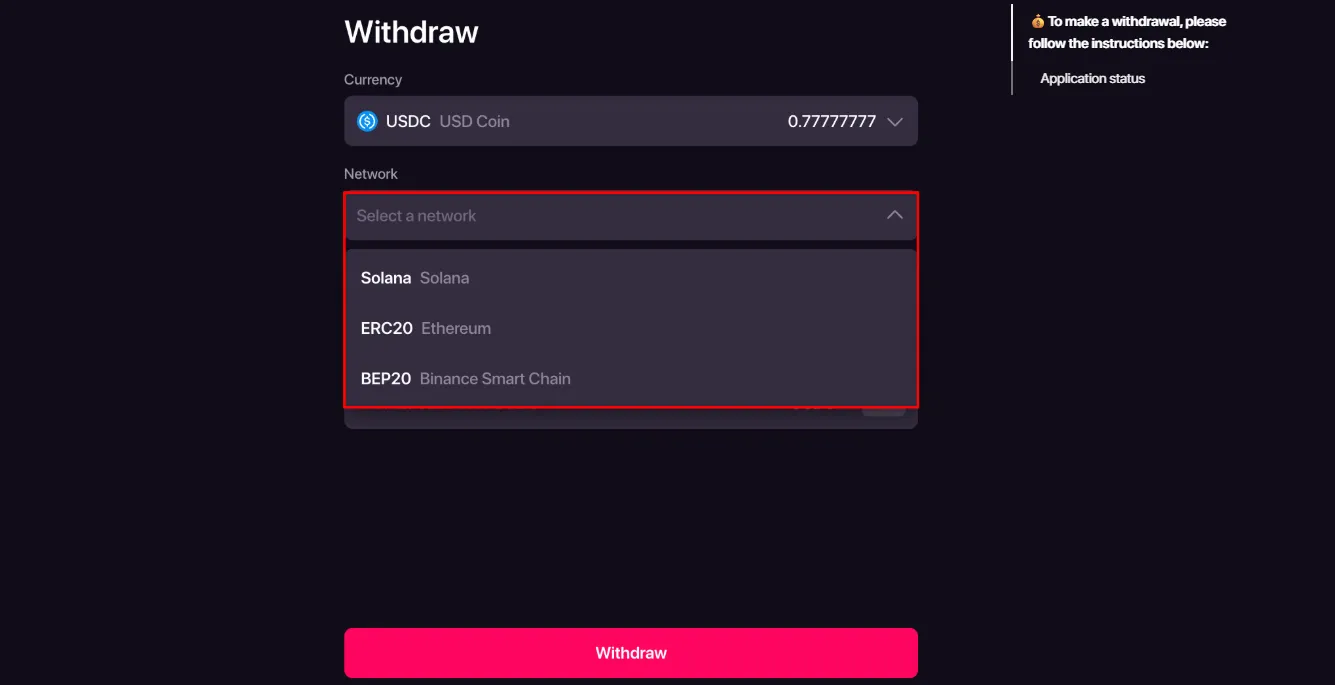
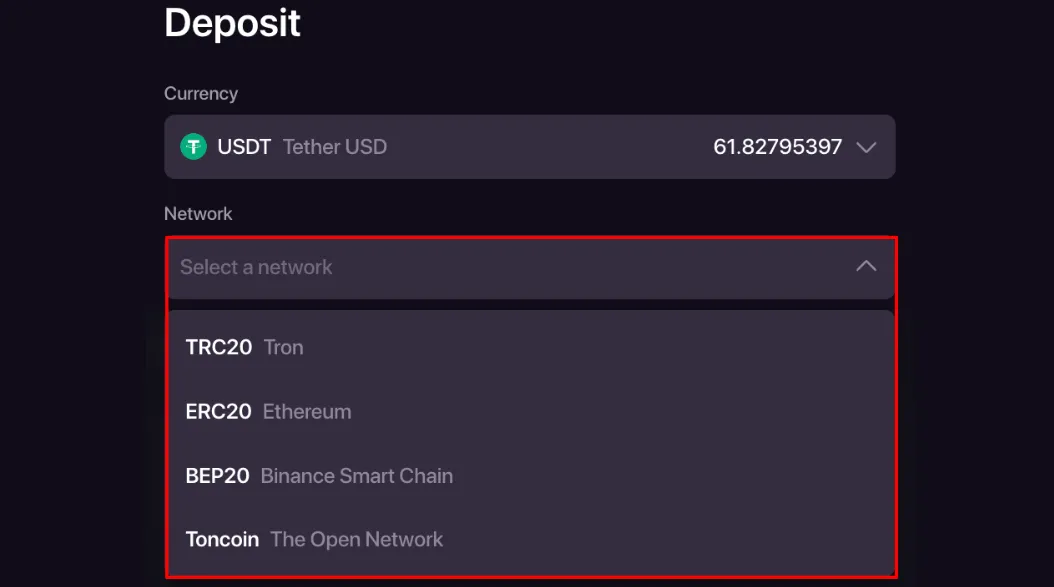
The available payment grid spans ERC-20, BEP-20, TRC-20, Polygon, TON, Bitcoin, Solana, Litecoin, and TRUMP. Several assets can exist on more than one supported network, so seeing a familiar ticker such as USDT or USDC does not remove the need to choose the correct chain.
This is the main operational difference between crypto funding and a familiar local transfer. With a standard local payment rail, the account or wallet service usually hides most routing decisions from the customer. With crypto, the network can be explicit. A USDT transfer on one chain is not interchangeable with USDT on every other chain. The sender’s network and the CHEXX deposit network need to match exactly.
Network check before sending
- Choose the asset inside the CHEXX cashier.
- Choose one of the networks shown for that asset.
- Confirm that your sending wallet supports the same network.
- Copy the deposit address carefully and preserve any required memo or tag shown by the live cashier.
- Review the asset, network, and destination together before confirming the transfer.
The CHEXX crypto payments guide goes deeper into this network-selection problem. This page stays focused on the broader Philippines payment fit and the distinction between local payment expectations and CHEXX’s actual cashier.
What the deposit minimums mean in practice
The available CHEXX information uses asset-and-network-specific deposit minimums rather than one universal minimum for the whole cashier. That design matters more than memorizing one number. The amount that applies to a stablecoin route does not automatically apply to Bitcoin, Solana, Litecoin, or another network-native asset.
For that reason, the live cashier should be the final checkpoint before a transfer. Select the asset and network first, then read the minimum displayed for that exact route. Do not infer a minimum from another coin, another network, a review page, or a previous deposit. A payment grid can change as networks, wallet providers, and operator settings change.
There is also no PHP conversion on this page. A crypto minimum can look small in token units while still representing a different peso value from one day to the next. Turning a live crypto amount into a fixed PHP figure would create false precision, especially for non-stablecoin assets.

No CHEXX deposit fee does not mean every transfer is cost-free
The available CHEXX information states that CHEXX does not charge a fee for accepting deposits. That is an operator-side statement. It does not eliminate charges that can arise elsewhere in the transaction path.
A sending wallet, exchange, or blockchain network can have its own fee model. Network conditions also affect what it costs to move an asset. These external costs are not the same thing as a casino deposit fee, so a useful payment review keeps them separate. Saying “CHEXX deposit fee: none” is narrower and more accurate than saying “deposits are free.”
Before funding, check the amount that will actually leave the sending wallet and the amount expected to arrive. If a service deducts a withdrawal or network charge before broadcasting a transfer, the received amount can differ from the amount entered on the sending side. That difference matters most when you are close to the cashier’s displayed minimum.
Why GCash and Maya are relevant without being CHEXX payment methods
GCash and Maya are prominent parts of the regulated Philippine e-money ecosystem, but that does not make them CHEXX deposit options. Their relevance is contextual: they help explain why a Philippine reader can reasonably search for “CHEXX GCash” or expect a peso-friendly digital payment flow.
The broader market is highly digital. Bangko Sentral ng Pilipinas reported that digital payments accounted for 57.4% of monthly retail payment volume in 2024. That environment makes local e-wallet and digital-transfer expectations normal. CHEXX stands apart from that expectation because its cashier set is crypto-only.
This difference should be treated as a fit question, not a workaround invitation. If you only want direct PHP or local e-wallet funding, CHEXX does not match that preference in the available payment information. If you already use cryptocurrency and understand wallet and network handling, the cashier is more aligned with your existing payment habits.
Philippine e-wallet rules add important context
Philippine payment policy changed materially in 2025. BSP Memorandum M-2025-029 suspended in-app gambling access from BSP-supervised institutions’ mobile payment apps and websites pending implementation of the corresponding policy. The memorandum instructed supervised institutions to remove links that redirect account holders from payment apps or websites to gambling sites.
PAGCOR also described mandatory de-linking of e-wallets from online gaming platforms as a player-protection and integrity safeguard. This policy context explains why “casino using GCash” has become a more complicated question than simply checking whether an operator displays an e-wallet logo.
None of this turns CHEXX crypto into a route around Philippine rules. Crypto funding is still a payment method used within the broader legal and regulatory environment. The useful conclusion is narrower: CHEXX does not rely on a direct PHP, GCash, or Maya cashier in the available CHEXX information, while Philippine regulators have separately tightened the connection between payment apps and online gambling access.
For the site’s detailed local regulatory discussion, use the CHEXX and PAGCOR page. Payment mechanics belong here; Philippine licence status and regulator scope belong there.
How to make a CHEXX deposit without confusing asset and network
A sensible crypto deposit flow is a verification sequence, not a speed test. Open the cashier, select a supported asset, select the exact supported network, and use the destination details shown for that route. Then compare those details with the sending wallet before authorizing anything.
The most important check is consistency. If CHEXX shows a BEP-20 route, the sending side also needs to use BEP-20. If the cashier shows a Bitcoin address, send Bitcoin through the Bitcoin route presented by the cashier. Do not choose a cheaper network merely because the asset ticker looks the same. A network mismatch is a routing problem, not a pricing optimization.
New users should also separate account setup from the payment step. The CHEXX registration guide covers sign-up and KYC context. Complete the account steps you need before transferring money so you are not trying to solve account-access and wallet-routing questions at the same time.
What “no maximum deposit limit established” should and should not mean
The available information does not establish a maximum deposit limit. That is a statement about the available source data, not a recommendation to fund a large amount. It also does not override any transaction-level limit that a wallet, exchange, network, compliance process, or live cashier can apply.
A practical way to use this information is to ignore it as a spending signal. Decide your personal entertainment budget first, then choose a deposit amount that stays inside it. Deposit-limit absence should never be reframed as a product advantage, because a higher possible transfer does not improve game value or reduce gambling risk.
If payment convenience is part of your trust assessment, combine this page with the CHEXX trust guide. A crypto-only cashier can be technically straightforward for an experienced crypto user and still be a poor fit for someone who wants a locally familiar payment route.
Deposits and withdrawals are related, but the risk questions are different
A deposit page answers what can be sent into the account and how the network selection works. A withdrawal page has additional high-risk questions: payout review, verification, destination checks, operator processing language, and network delays. Those topics should not be collapsed into a single “payments are fast” claim.
Use the CHEXX withdrawals guide for payout-specific rules and verification notes. It separates the operator’s current 24/7 withdrawal commitment from exact processing-time promises that are not established for every network. That separation is important because a deposit arriving quickly does not prove that every withdrawal will follow the same timing pattern.
Who the CHEXX cashier fits best
Good fit
You already hold one of the 11 supported assets, understand blockchain networks, and are comfortable checking wallet addresses before sending.
Less convenient fit
You want a direct PHP payment flow or expect to fund the casino from GCash or Maya as a listed cashier method.
Needs extra care
You hold a supported token on several chains and usually choose networks based only on fee or speed without checking the receiving network first.
Worth reviewing first
You are new to crypto transfers and have not previously dealt with irreversible wallet-address or network-selection errors.
CHEXX deposit checklist for Philippine users
- Confirm that crypto-only funding suits you before creating a payment plan around CHEXX.
- Do not assume PHP, GCash, Maya, or a local bank transfer is directly supported.
- Select one of the 11 supported crypto assets inside the live cashier.
- Match the sending network to one of the nine CHEXX networks shown for that asset.
- Read the live minimum for the exact asset-and-network combination rather than borrowing a number from another route.
- Separate CHEXX’s no-deposit-fee statement from wallet, exchange, or blockchain costs.
- Check the full destination details before sending, because crypto transfers are not handled like reversible card payments.
- Keep your deposit inside a pre-set gambling budget regardless of the absence of a stated maximum.
A simple way to compare CHEXX with a local-payment casino
Compare the number of steps between your existing money and a usable casino balance. With a direct PHP or e-wallet casino, the route can stay inside familiar local payment rails. With CHEXX, the approved route starts with cryptocurrency, so a user who begins with pesos needs an external way to acquire a supported asset before reaching the CHEXX cashier. That extra step can add conversion cost, network choice, and wallet-management work even when CHEXX itself charges no deposit-acceptance fee.
This is why payment fit should be judged by process rather than by the number of supported coins. Eleven assets and nine networks provide choice for crypto users, but they do not recreate the convenience of direct GCash, Maya, or PHP funding. A smaller payment menu can be more convenient if it matches the way you already manage money.
Bottom line: strong crypto coverage, weak local-payment fit
CHEXX has broad crypto coverage for a casino cashier: 11 assets across nine networks. That is the central payment fact. For a Philippine reader, the equally important fact is what the cashier does not provide in the data: direct PHP fiat funding, GCash, and Maya are not listed CHEXX payment methods.
This creates a clear trade-off. Experienced crypto users get multiple asset and network choices, while users who prefer a peso-first or e-wallet-first flow face an extra conversion and wallet-management layer outside CHEXX. The operator-side deposit fee is listed as none in the available information, but external network or wallet costs remain separate. Which coins and chains work: the crypto page.
Use the cashier as a network-routing decision, not just a list of coins. Check the asset, network, destination, and live minimum together, and never treat crypto as a shortcut around Philippine payment or gambling rules. For payout mechanics, continue to the dedicated withdrawal guide rather than assuming deposit behavior predicts withdrawal behavior.
 Sweet RewardBF Games
 Book of the SunPascal Gaming
 StarburstNetEnt
 CleopatraIGT
 Gates of OlympusPragmatic Play
 9 Arrows of OdysseusSpinOn
 Astro GemsMaverick
 Trickstar SpinsYggdrasil Gaming
 Sizzling Hot DeluxeNovomatic
 Love Gems Hold and Win1spin4win
 Maneki FortunesSkywind Group
 The Boom SquadGenesis Gaming
 Tiger RushThunderkick
 Multihand BlackjackMultihand
 Turbo BlackjackFast-play
 European BlackjackMultihand
 Vegas Strip BlackjackClassic
 Atlantic City BlackjackClassic
 Blackjack 21 ClassicClassic
 Blackjack Lucky LadiesSide Bet
 VIP American BlackjackVIP
 Perfect Pairs BlackjackSide Bet
 Single Deck Blackjack GoldSingle Deck
 American BlackjackClassic
 Double Exposure BlackjackDouble Exposure
 Quantum Blackjack PlusMultiplier
 Blackjack Surrender OriginsSurrender
 Vegas Downtown Blackjack GoldGold Series
 Who Wants to Be a Millionaire RouletteThemed
 Roca Riches RouletteThemed
 Multifire RouletteMultiplier
 Immortal Romance RouletteThemed
 Mega Fire Blaze RouletteMultiplier
 Quantum RouletteMultiplier
 American RouletteClassic
 French RouletteNetEnt
 Monopoly Roulette TycoonThemed
 RouletteRelax Gaming
 European RouletteClassic
 Dragon RouletteThemed
 Double Ball American RouletteDouble Ball
 Auto RouletteSwitch Studios
Created by the ”Chexx Casino” editorial team.